On greatness, humility, and penguins in the anthropocene.
At the 2025 SAG Awards, Timothée Chalamet did something mildly scandalous. He spoke plainly.
“I’m really in pursuit of greatness. I know people don’t usually talk like that, but I want to be one of the greats.”
In a cultural economy where ambition must be disguised as accident and confidence laundered through self-deprecation, Chalamet’s statement felt almost transgressive. Pearls, I’m sure, were clutched. No faux modesty. No ironic shrug.
And honestly? In his case, it works.
I don’t know Lil Timmy Tim, nor would I specifically call myself a fan, but his public persona, while carefully cultivated, seems to understand that claims to greatness are not neutral. They come with responsibility, with risk, with a tacit knowledge that cinema as an art form is wobbling under the weight of franchise fatigue and algorithmic cowardice. His ambition (however Kardashianesque it is) reads less like domination than as devotion, like someone slamming an epipen into the heart of his much loved livelihood.
But sincerity, once released into the machinery of contemporary capitalism, rarely remains intact.
The cultural afterlife of his SAG speech has metastasised into something far less reflective. Supercharged by the hyper-marketing of Marty Supreme and its attended mythology of ‘total commitment’, what began as a nuanced articulation of belief in one’s craft has been absorbed into familiar neoliberal verbiage, i.e., succeed at all costs, commit or die, eliminate retreat for it is the most efficient way to success, in short – hustle individualism.
Don’t get me wrong, determination, focus, and self-belief are admirable qualities, but abstracted from context they curdle into dogma. This is sincerity marketing at its finest. It teaches us which emotions are productive and which are liabilities. Humility? Weak. Doubt? Indecisive. Reflection? Indulgent. Bravado, however, is scalable and marketable.
In tandem with this speech from Timmy and the Marty Supreme ethos of total commitment, comes the desperate desire by audiences to embody this marketing juggernaut dressed up as a philosophy of life. My own doomscrolling on Instareels has been flooded recently with influencers internalising and trying to replicate this into a way of being. In particular, ‘mano-sphere’/’grind-set’ influencers have grasped this with both hands. Set to cinematic music, staring into the middle distance, with a solemnity that lets the audience know that they, like Marty, are God’s strongest soldier, and their message is clear – if you believe in your dream hard enough, you must destroy and abandon everything in your life that poses a hurdle to this dream, including destroying all possibility of retreating from your own epic destiny.
So. These neoliberal hustlers, in their horny desperation to be a ‘Martyr’ Supreme and propel themselves into ultimate ‘success’, have virally begun to circulate the motivational metaphor du jour, burn the ships. This means, believe in yourself so completely that you destroy the possibility of retreat – you burn the ship on which you arrived at your current point in life so you cannot go backwards only forwards.
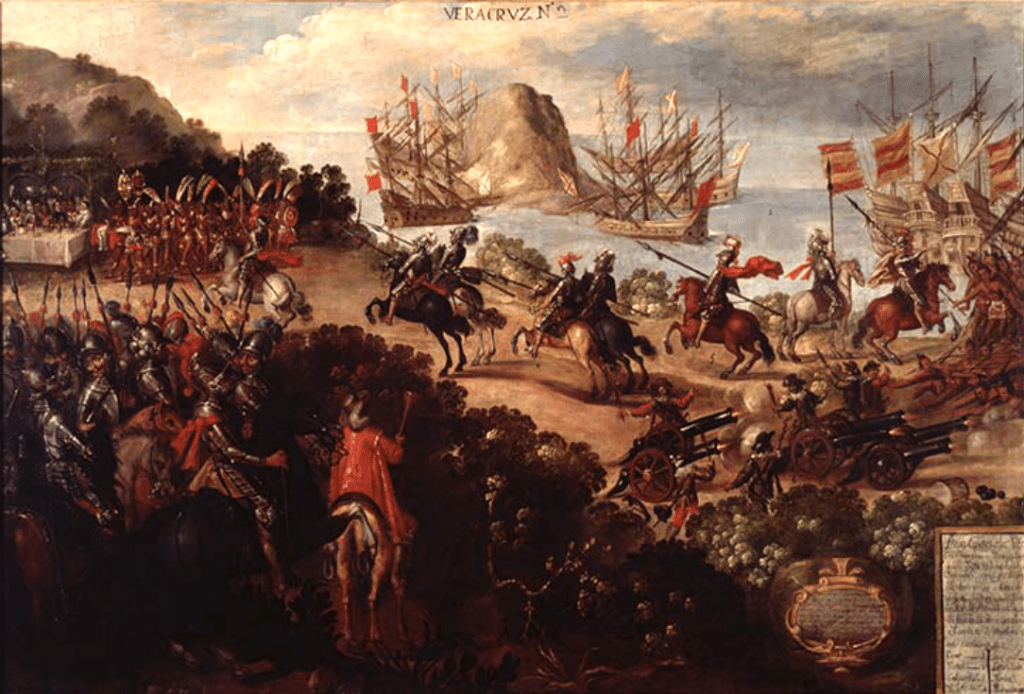
This metaphor is not an abstract call to self-belief. Historically, it was a tactic of conquest and outright colonisation. To momentarily indulge my history degrees: you may be curious yourself about the historical contexts accounting for this phrase, and one google search will reveal a labyrinth of messy tall tales and a truly frightening lack of primary source material, revealing most of the lore surrounding ‘burning the ships’ to be entirely apocryphal.1 Most recently, this phrase ‘burn the ships’ is attributed to the conquistador Hernán Cortés who led the expedition that brought about the fall of the Aztec Empire. Not to break the hearts of military history boys everywhere, but this attribution too is a mythologisation.2 In a much later aggrandisement, Cortés’ successful capture of Veracruz in 1519 was attributed with the definitive command of scuttling their own ships to eliminate any possibility of retreating from total control of this ‘new’ land.
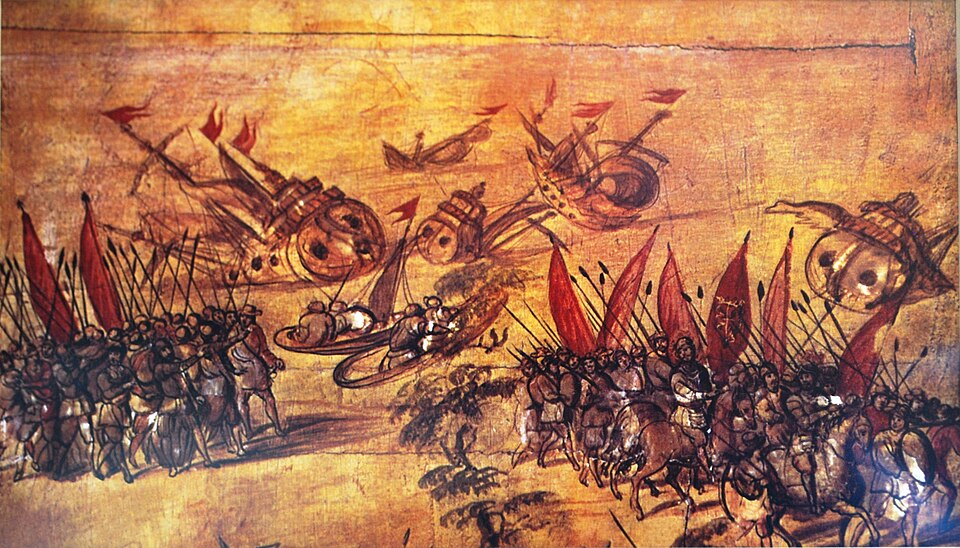
While fact vs fiction/real vs not-real matters in the sense of attribution, what matters more is that clearly, despite lack of evidence, contemporary culture desperately wants this to be true of some conqueror at some point in time. The myths persist because it flatters a fantasy of irreversible commitment, heroic masculinity, and conquest as character building. And modern self-help culture cheerfully strips this history of domination and colonialism, repackaging it as a productivity life hack. One motivational blog I came across literally asks ‘How can you burn the ships in your own life?’.
With all due respect, this is unhinged.
The idea that you might be able to burn your ships, your hurdles, your past hindrances, and drive forward into some ultimate solo domination of your destiny is part of the big shadow over our communities where neoliberalism and individualism thrives. False binaries become the only moral framework markers, i.e., success/failure, winner/loser, mastery/submission, human/nature, which ecological and feminist philosophers have been dismantling for years. Val Plumwood, for example, exposed the destructive nature of these dualisms and their legitimisation of domination, and yet they persist constantly, particularly in the West. In this framework, humility is positioned as the opposite of ambition, as though recognising our limits negates agency. But humility, properly understood, is not self-erasure. It is an epistemic stance that acknowledges we are partial, entangled, and dependent on the world and people around us. That no one arrives anywhere alone. Donna Haraway explicitly said we must stay with the trouble, embrace the messiness and uncertainty of living on a damaged earth in damaged systems of community, not torch our past or our exits.3
The fantasy of burning the ships demands that we disavow this entanglement. It asks us to forget the ecological, social, cultural, economic, and historical infrastructures that have carried us to our present and will continue to carry us beyond. No one can sail a ship on their own – you didn’t reach your current shores without everything that went into sailing you there. Our ships, therefore, matter and are conditions of our possibility.
Humility, therefore, is a non-negotiable in the Anthropocene. Not as a performance, but as a praxis. You are not an individual, everything you have done, are doing, will do, is located somewhere and relational to someone. Retreat is not failure, and care and interdependence are not moral weaknesses, they’re survival skills.
Now, those astute readers who have made it this far may have noticed that the penguins from the subtitle have yet to enter this discourse. They’ve been waiting in the wings for me to pull the ultimate Mark Fisher and pop-culture the heck out of my point.
The internet fascination with ‘burn the ships’ is oddly echoed in another viral figure, the penguin from Werner Herzog’s 2007 Encounters at the End of the World. The famous clip which has made a recent resurgence on Tiktok and Instagram, and in magazines parsing this meme4, shows a lone penguin separating from its colony, not turning to the ocean to feed, but retreating inland to the Arctic interior where there is nothing but ice, distance, and certain death. The cultural associations of this penguin have identified it as an icon of nihilism, and the resonance with people on the internet is telling. Because people have lauded him as an absurdist hero, refusing the path most travelled; ‘the other penguins survive, but he lives’. But why then does his apparent heroicism feel so emotionally grave and futile? Because neoliberal capitalism has made isolation and individualism feel like authenticity. Loneliness has been reframed and remarketed as bravery.
For sanity’s sake we must not imagine the penguin happy, he is not Camus’ hero. His tragedy is misread as transcendence. Herzog in his voiceover describes the penguin as ‘disoriented’ and ‘deranged’. There is not a quest for enlightenment to be understood here, it’s disintegration. Penguins are not solo creations, and they cannot survive without collective persistence. Season 3 episode 6 of Atypical outlines this, where Sam offers a far more grounded philosophy on his special interest topic of penguins:
“Penguins live in abnormally harsh conditions and they never leave. They’re one of the few species that stays, struggles and perseveres. So to me, that’s the essence of a penguin. It stays.”
This distinction matters. Staying is not stagnation it is commitment without fantasy or the mythology of conquest. In a true mirror of Haraway philosophy, penguins persist not by rejecting their environment or their colony, but by adapting together to the harsh climate that is their home and finding meaning despite inhospitability.
Which brings us improbably but so necessarily to the wisest of penguins, Zeke “Big Z” Topanga. Surfs Up offers us a bridge between success, collectivity, and humility when Big Z sagely spurs Cody, the young surfing wunderkind, with forward looking advice.
“Never give up. Find a way. Because that’s what winners do.”
Finding a way does not mean narrowing one’s life into a single violent trajectory toward ‘greatness’. It means working with the world as it is rather than against imagined absolutes, and that, as Big Z says, is what makes someone truly great.

So, Chalamet’s pursuit of greatness, at its best gestures towards these complexities. Where this ambition fails is not the desire itself, but its capture by a culture that confuses domination and mastery for success and greatness. We do not need more people burning the ships. We need people who understand how to sail together, aware of the waters we are in and yet to face, accountable to the crew, and humble enough to know that greatness, if it even exists in this epoch of metacrisis, is never achieved alone.
- To name a few: Alexander the Great is very randomly and modernly attributed with this unsubstantiable command in his conquest of Persia, and Caesar too (though Caesar did burn his own fleet during the Siege of Alexandria, but this was to stop this naval resource from falling into the hands of Egypt – see Caes.Civ.3.111).
The Shiji record by Sima Qian and Sima Tan accounts in the Annals of Xiang Yu that in 207BC at the Battle of Julu the Chinese warlord Xiang Yu ordered his army to break the kettles and sink the boats ‘破釜沉舟’ so as to show his soldiers that they must be determined to fight until victory or death.
Tariq ibn Ziyad, an Umayyad commander inciting Muslim conquest of Iberia in the 8th-century, was first reported 400 years after the fact in the Nuzhat al-mushtāq fī ikhtirāq al-āfāq geography account by al-Idrisi, to have ordered the ships he arrived in to be burnt ‘فٱمر بإحراق المراكب’, preventing cowardice or retreat by his army (fasc.5.540). ↩︎ - E.g., Reynolds, W. (1959). The Burning Ships of Hernán Cortés. Hispania(Vol. 42, No. 3), 317-324. ↩︎
- Haraway, D. (2016). Staying with the Trouble: Making Kin in the Chthulucene. Duke University Press. ↩︎
- See Forbes, The Independent, or The Economic Times alike. ↩︎

 1D3S
1D3S 
Leave a reply to arthurrumsey Cancel reply